Nonsense
Conversations in Cone Bras and Candlelight
I’ve written before about my tortuous, highly emotional, and entirely unnecessary process of choosing my next read. It’s a convoluted, multidimensional selection ritual: 50% science, 50% programming, 100% trauma. At a recent business dinner, a good friend suggested I add The Second Sleep by Robert Harris to the list. Naturally, this prompted an outburst of self-indulgent moaning about the rigidity of my reading system and the sheer terror some titles inspire (Finnegans Wake and Middlemarch, I’m looking at you).
My friend then asked if I’d read “War and Peace”, to which I nodded sagely and launched into a deeply convincing soliloquy about Tolstoy, moral clarity, and the nobility of rustic labour. Which isn’t quite true. In fact, I can’t remember much about the book beyond the vague sense that I read it sometime in the previous century. To cover my tracks, I claimed to prefer Dostoevsky—a statement that was technically true, though my pretentious-ometer was by this point making an audible whine.
That night, I got home and asked myself honestly: Why do I prefer Grumpy Fyodor to Grumpy Leo?
It’s tempting to say quantity: I’ve read more Dostoevsky novels than Tolstoy’s. But that doesn’t hold—War and Peace alone could count as four books, which, as I recently checked, it literally is.
Then, I remembered another dinner.
It was also vaguely business-related: backstage, during my brief and under-documented stint as a backup dancer on Madonna’s Blond Ambition World Tour. Strangely, no one remembers my presence. Something about a cone bra stealing the spotlight.
Anyway, there we were, listening to the Big M regale us with tales of the famous people she’d encountered. The stories were glamorous, irreverent, celebratory. That is, until someone brought up nineteenth-century Russian novelists.
The room fell silent.
No one dared speak first. Then, with a dampness in her eye, she told us of the times she’d met Fyodor and Leo.
She’d dressed down for the occasion—out of respect—and met Leo Tolstoy in his candlelit study. He was barefoot, in homespun linen, naturally.
Madonna:
You live like this… on purpose?
Tolstoy (nodding):
Luxury poisons the soul. A simple life allows for truth. And you—you seem to have devoted your life to distractions.
Madonna:
I’ve devoted it to performance. Art. Self-expression. Provocation.
Tolstoy:
Provocation is not art. It is noise. True art uplifts. It speaks to the divine in man. Yours speaks to… the market.
Madonna (shrugs):
Look, I didn’t set out to be a prophet. I wanted to challenge norms. Religion. Gender roles. Power. That’s not meaningless.
Tolstoy:
To challenge is not enough. Why do you challenge? For what purpose? You use the tools of the world—fame, wealth, vanity—and believe you are above them?
Madonna:
You think I’m vain. I think I’m free. You wrote books to shake the system. I danced on stages. Same revolution. Different shoes.
Tolstoy (quietly):
You mistake visibility for truth. There is a kind of slavery in constant performance. The soul needs silence.
Madonna:
You really think someone like me can’t make meaningful art?
Tolstoy:
Anyone can. But art becomes meaningful when it forgets the self. When it loves others more than its own reflection.
Madonna:
That’s beautiful. Still… I like mirrors.
Tolstoy (smiling for the first time):
Yes. I imagine you do.
My fellow dancers and I all understood the subtext of the story immediately. How our Lady Madonna represented unapologetic self-expression and rebellion through spectacle. While Tolstoy championed humility, asceticism and moral clarity. They didn’t agree, but they listened. And in our current age, that is perhaps the most meaningful art of all.
We stopped our schoolgirl chatter when Madonna began again, this time she spoke of her meeting with Dostoevsky in a smoky corner of the Literaturnoye Kafe in St Petersburg. He in a threadbare coat, she dressed in a sleek, silken, dark dress. Her alabaster skin glowing in the candlelight.
Dostoyevsky (squinting at her):
You are not what I expected. I thought you would be louder.
Madonna (raising an eyebrow):
And I thought you’d be taller.
Dostoyevsky (smirking):
Tell me… does it tire you? The mask?
Madonna:
What mask?
Dostoyevsky:
The one that lets you command a stage. The one that shouts freedom, while hiding the terror underneath.
Madonna (leaning in and brushing her lips against his ear):
Maybe I wear masks to survive. Maybe we all do. You should know—you wrote the book on tortured selves.
Dostoyevsky:
Ah, but I sought truth through my torment. You turn torment into choreography.
Madonna:
That is art. And art isn’t always about truth. Sometimes it’s about escape. Or defiance. Or just being seen.
Dostoyevsky (nodding slowly):
Being seen. Yes. The modern disease. Everyone shouting, no one listening. But I sense… you do want to be heard, not just admired.
Madonna:
Maybe. Maybe I’m still figuring out what I want to say. But I’ve survived by saying something—anything—before anyone else could say it for me.
Dostoyevsky:
So fear drives you?
Madonna:
Fear. Anger. Hunger. Ambition. Love. I’m human, Fyodor. Same as you.
Dostoyevsky (smiling faintly):
You are more honest than many priests. That, I admire.
Madonna:
So you don’t hate me?
Dostoyevsky:
No. But you interest me. You are the Underground Woman. With exceptional cheekbones.
And, with that, she left the backstage and I never saw her again. What I liked about her second story was that unlike Tolstoy, Dostoyevsky didn’t try to correct Madonna. He sought to understand her contradictions and reflect on his own. They did not agree on what art should be, but they recognised in each other the same obsession: with freedom, with identity and with the abyss that stares back at both.
I had thought to write a very silly sketch about Madonna meeting the two great writers when I started this post, but somehow I think the sheer weight of historical reverence and unparalleled gravatas of the two of them created a vortex of profundity which no sort of satire(?) can escape, drawing everything into a strange but possibly genuine meditation on what art really is.
Still, I also made a little cartoon:
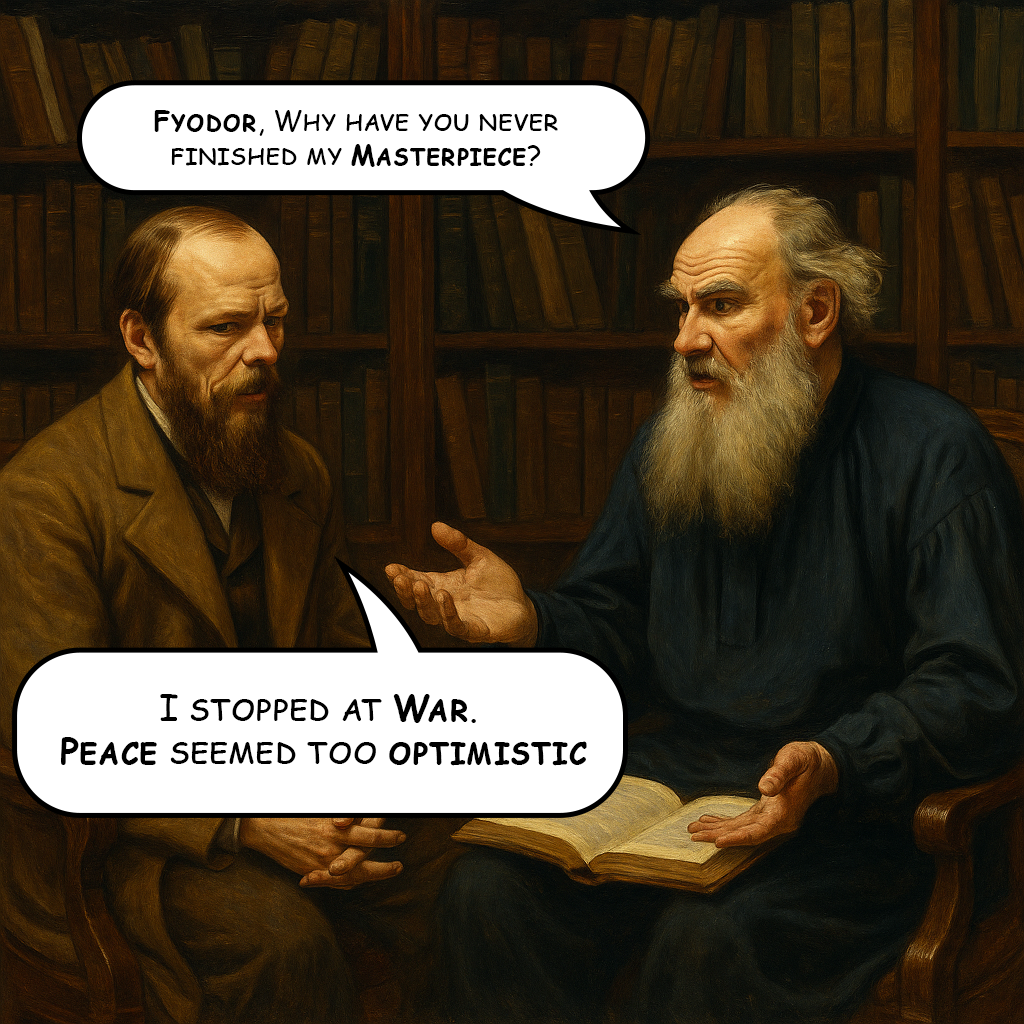
Sometimes, I suppose, silliness and seriousness go hand in hand. Or at least, sit at opposite ends of the same candlelit table.
How I Know I’m a Writer
There are times when I doubt myself.
The past year for example: I started 2024 with good intentions – I didn’t write much other than a couple of blog entries, but I read some complicated books and kept “write for at least an hour” on my TODO lists all year… even though I never actually wrote for a full hour in one day.
So you can see why the doubts are there.
But every now and again, I read a novel or a short story or a chapter that inspires me so much that I can’t stop thinking about it and how I should be creating something like that.
Last night while reading Steven Erikson’s The Deadhouse Gates I came across a sentence which thrilled me in the same way that a whole novel sometimes does.
“The historian noted that he was not alone in his trepid attention.”
I don’t think I’ve ever seen trepid anywhere other than as the first part of trepidation. “He looked on in trepidation…” is, to me, a horrible cliché – an insipid example of lazy writing.
This, on the other hand, is glorious and has reminded me how simple, yet infinitely varied, writing can be.
It’s possibly a very personal thing, and it’s definitely a nauseatingly smug thing, but this has convinced me that above all else: I AM A WRITER.
The Final New Dawn… until the next one.
Believe it or not, I’m working too hard. Anyone who knows me would find this laughable as I have made an art form of finding an ingenious solution to a problem at the last minute, which makes everyone think I’m much cleverer than I am.

Recently I seem to have taken on more responsibilities, and now find myself slaving away at all hours trying to find answers to problems that are very much not novel related or, in fact, writerly in any way. The cold, hard logic problems of software engineering.
And I think it’s affecting me. I’ve always bemoaned my lack of ability to focus on one project or topic – often blaming it for my failures. It’s extremely easy to say that the reason I haven’t had a novel published is because I’m too much of a polymath, my mind is too vast to be constrained by a single goal and therefore I need to unfetter it and let it wander its own path.
It’s much harder to admit that I just lack discipline and am genuinely an Olympic level procrastinator.
However, my recent attention to one subject (my actual job) has proven to me that I can concentrate. I can bring my (probably not as great as I think it is) intellect to bear entirely onto one subject. I do know what it takes to get things done. And I am perfectly capable of sitting down and doing the thing I’m supposed to be doing.
I just need to do it.
So, obviously, I have now decided, once more, that my dearest desire, my one true calling, the gold at the end of the rainbow is writing. If I want to remain fed, clothed and housed, I cannot stop doing my job, but outside of working hours I am going to concentrate entirely on one thing.
I realise that a healthy mind requires a healthy body which means I should still do a bit of cycling and squash. Maybe a couple of workouts to keep my body and mind supple and capable. And I do want to utilise my games programming muscles.
So, I am now going to focus entirely on this list:
- Finishing “The Motley Life of Edison Swift” before end of June 2022
- Writing two blog posts every week
- Getting The Literarium up and running
- Write a fantastic author helping tool
- Distribute my multidimensional thesaurus to the world
- Create a fabulous Patreon presence
- Ride my bike more
- Get 2,500 SquashLevel points
- Write a working version of Chesster
I think I’ll be much happier now that I’ve only got one thing to do.
Watching The Ashes with Dad
I didn’t cry very much when my dad died. There was just too much to do, too many other people to support. I was devastated, but it was the type of tragedy that required resilience and pragmatism, not reflection and melancholy.
I’ve certainly always missed him over the past almost twenty years and I’ve tried to live up to his rigid sense of fair play. If I’ve ever shirked a responsibility or taken the easier (but wrong) path it is always to him that I apologise. And that acknowledgement has always made me think and act differently next time a similar situation arises.
Today, however, while watching the morning session of the Headingley Test match I made up for my lack of tears by imagining what it would have been like had I been able to share the experience with my dad.
The story of the match has led to an exciting conclusion today and my better half is at work all day. I might have rung him up last night and invited him down to watch England snatch an improbable victory from the Aussies.
And so, there we would have sat watching the action in a definition that dad could have hardly dreamed about. He would have loved the recent technologies, Hawkeye, Edge Detection, HotSpot, Ball Spin and all the statistics that come with them. He would have despaired at the Decision Review System which leads to a seeming fallibility of modern umpires. Cricket, like my dad, has always been a solid mix of the traditional and the innovative.
There wouldn’t have been any long conversations, just the occasional observation or recounting of an old story. The most repeated phrases would have been familiar two words, “Good shot”, “Well left”, or in extreme circumstances, “What a shot, ball, catch…” We might have argued about who the best players were, but this would have come down to their work ethic and determination rather than talent.
We would have shared every laugh and cheer though. And this is what has made the day so poignant. At the time of writing Jofra Archer has been caught in the deep so England now require 73 with only two wickets remaining, so a famous victory is unlikely.
Now, perhaps, we would have talked about more personal things. He’d ask about work, about the kids, about everything. I hope he would have been proud of me. I’d like to think he can rest peacefully.
To Estimate or Not To Estimate
I was trying to explain the difference between my job and my better half’s job to my daughter when she pointed out that the company I worked for was quite small.
“There’s only about nine people at your work, isn’t there?” She said.
“Yes. There’s ten.” I replied.
“Well,” she said, fixing a beady eye on me and crossing her arms. “I said ‘about nine’, didn’t I?”
“Yes, darling. You did. I was just pointing out that there were exactly ten.”
“And does it make a huge difference?” He arms were folding themselves tighter and tighter and her eyes becoming beadier.
“No.” I said. “Not really. But if you’re giving someone an estimate, you would usually round it up. In this case to ten.”
“Really.” It was not a question.
“Yes. Really. You wouldn’t say :’There are nine hundred and ninety five thousand, four hundred and thirty somethings’ if you thought there were about a million somethings, would you?”
“I would.”
“Well that’s silly, darling.”
“Ask me how many minions Gru has in Despicable Me.”
I fought back a sigh. “How many minions does Gru have?”
“Nine hundred and ninety five thousand, four hundred and thirty… one.”
“Exactly?”
“No. About nine hundred and ninety five thousand, four hundred and thirty one.”
“Well that’s about a million, isn’t it?”
“Yes. But it’s also about nine hundred and ninety five thousand, four hundred and thirty one.”
“This is true, darling. But isn’t it easier to just say, about a million?”
“No.”
“OK.”
There was a bit of a silence.
Then she said: “How many dads are there in the world?”
The question was asked without particular menace, but after a quick calculation I’d worked out that there were a lot of potential replacements for me.
“About two and a half billion.”
Another silence.
“And how did you work that out?”
“Well, there’s about seven billion people in the world…”
“Are there exactly seven billion?”
“No, of course not.”
“HA! Then why not say ten billion people? Are you an idiot? You’ve just told me that if you’re estimating something you should round it up. And now you say seven!”
She was not interested in the rest of my calculations.
She is about twenty years old. But exactly eleven.