Conversations in Cone Bras and Candlelight
I’ve written before about my tortuous, highly emotional, and entirely unnecessary process of choosing my next read. It’s a convoluted, multidimensional selection ritual: 50% science, 50% programming, 100% trauma. At a recent business dinner, a good friend suggested I add The Second Sleep by Robert Harris to the list. Naturally, this prompted an outburst of self-indulgent moaning about the rigidity of my reading system and the sheer terror some titles inspire (Finnegans Wake and Middlemarch, I’m looking at you).
My friend then asked if I’d read “War and Peace”, to which I nodded sagely and launched into a deeply convincing soliloquy about Tolstoy, moral clarity, and the nobility of rustic labour. Which isn’t quite true. In fact, I can’t remember much about the book beyond the vague sense that I read it sometime in the previous century. To cover my tracks, I claimed to prefer Dostoevsky—a statement that was technically true, though my pretentious-ometer was by this point making an audible whine.
That night, I got home and asked myself honestly: Why do I prefer Grumpy Fyodor to Grumpy Leo?
It’s tempting to say quantity: I’ve read more Dostoevsky novels than Tolstoy’s. But that doesn’t hold—War and Peace alone could count as four books, which, as I recently checked, it literally is.
Then, I remembered another dinner.
It was also vaguely business-related: backstage, during my brief and under-documented stint as a backup dancer on Madonna’s Blond Ambition World Tour. Strangely, no one remembers my presence. Something about a cone bra stealing the spotlight.
Anyway, there we were, listening to the Big M regale us with tales of the famous people she’d encountered. The stories were glamorous, irreverent, celebratory. That is, until someone brought up nineteenth-century Russian novelists.
The room fell silent.
No one dared speak first. Then, with a dampness in her eye, she told us of the times she’d met Fyodor and Leo.
She’d dressed down for the occasion—out of respect—and met Leo Tolstoy in his candlelit study. He was barefoot, in homespun linen, naturally.
Madonna:
You live like this… on purpose?
Tolstoy (nodding):
Luxury poisons the soul. A simple life allows for truth. And you—you seem to have devoted your life to distractions.
Madonna:
I’ve devoted it to performance. Art. Self-expression. Provocation.
Tolstoy:
Provocation is not art. It is noise. True art uplifts. It speaks to the divine in man. Yours speaks to… the market.
Madonna (shrugs):
Look, I didn’t set out to be a prophet. I wanted to challenge norms. Religion. Gender roles. Power. That’s not meaningless.
Tolstoy:
To challenge is not enough. Why do you challenge? For what purpose? You use the tools of the world—fame, wealth, vanity—and believe you are above them?
Madonna:
You think I’m vain. I think I’m free. You wrote books to shake the system. I danced on stages. Same revolution. Different shoes.
Tolstoy (quietly):
You mistake visibility for truth. There is a kind of slavery in constant performance. The soul needs silence.
Madonna:
You really think someone like me can’t make meaningful art?
Tolstoy:
Anyone can. But art becomes meaningful when it forgets the self. When it loves others more than its own reflection.
Madonna:
That’s beautiful. Still… I like mirrors.
Tolstoy (smiling for the first time):
Yes. I imagine you do.
My fellow dancers and I all understood the subtext of the story immediately. How our Lady Madonna represented unapologetic self-expression and rebellion through spectacle. While Tolstoy championed humility, asceticism and moral clarity. They didn’t agree, but they listened. And in our current age, that is perhaps the most meaningful art of all.
We stopped our schoolgirl chatter when Madonna began again, this time she spoke of her meeting with Dostoevsky in a smoky corner of the Literaturnoye Kafe in St Petersburg. He in a threadbare coat, she dressed in a sleek, silken, dark dress. Her alabaster skin glowing in the candlelight.
Dostoyevsky (squinting at her):
You are not what I expected. I thought you would be louder.
Madonna (raising an eyebrow):
And I thought you’d be taller.
Dostoyevsky (smirking):
Tell me… does it tire you? The mask?
Madonna:
What mask?
Dostoyevsky:
The one that lets you command a stage. The one that shouts freedom, while hiding the terror underneath.
Madonna (leaning in and brushing her lips against his ear):
Maybe I wear masks to survive. Maybe we all do. You should know—you wrote the book on tortured selves.
Dostoyevsky:
Ah, but I sought truth through my torment. You turn torment into choreography.
Madonna:
That is art. And art isn’t always about truth. Sometimes it’s about escape. Or defiance. Or just being seen.
Dostoyevsky (nodding slowly):
Being seen. Yes. The modern disease. Everyone shouting, no one listening. But I sense… you do want to be heard, not just admired.
Madonna:
Maybe. Maybe I’m still figuring out what I want to say. But I’ve survived by saying something—anything—before anyone else could say it for me.
Dostoyevsky:
So fear drives you?
Madonna:
Fear. Anger. Hunger. Ambition. Love. I’m human, Fyodor. Same as you.
Dostoyevsky (smiling faintly):
You are more honest than many priests. That, I admire.
Madonna:
So you don’t hate me?
Dostoyevsky:
No. But you interest me. You are the Underground Woman. With exceptional cheekbones.
And, with that, she left the backstage and I never saw her again. What I liked about her second story was that unlike Tolstoy, Dostoyevsky didn’t try to correct Madonna. He sought to understand her contradictions and reflect on his own. They did not agree on what art should be, but they recognised in each other the same obsession: with freedom, with identity and with the abyss that stares back at both.
I had thought to write a very silly sketch about Madonna meeting the two great writers when I started this post, but somehow I think the sheer weight of historical reverence and unparalleled gravatas of the two of them created a vortex of profundity which no sort of satire(?) can escape, drawing everything into a strange but possibly genuine meditation on what art really is.
Still, I also made a little cartoon:
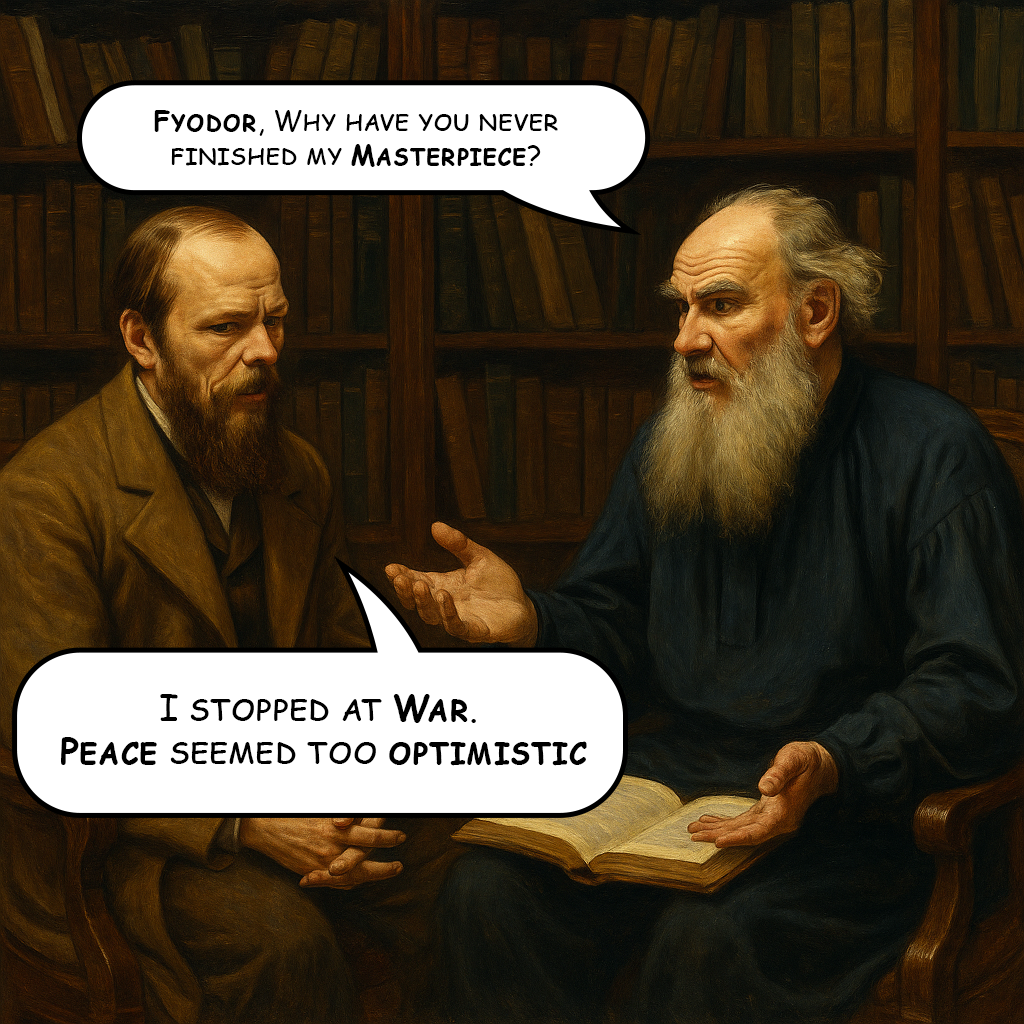
Sometimes, I suppose, silliness and seriousness go hand in hand. Or at least, sit at opposite ends of the same candlelit table.
God Mode and Chocolate Cake: Why We Idolise the Ordinary Over the Exceptional
In today’s society, we seem increasingly drawn to celebrities of no particular distinction—people who are famous not for talent, intelligence, or meaningful contribution, but simply for being visible. Reality TV stars, influencers, and social media personalities dominate headlines and screens, often celebrated for little more than their lifestyle, personal drama, or follower count. Meanwhile, true brilliance—scientists, artists, thinkers, or quiet innovators—often goes unnoticed, their achievements too nuanced or complex to fit into a tweet or a 15-second video on TikTok.
This isn’t entirely new. People have been lamenting the dumbing down of culture for decades. But the scale and intensity of this trend feels different now. A Nobel laureate may get a passing mention in the news, but a reality TV star’s dating life will dominate media cycles for weeks.
One of my favourite videos on YouTube is Prince absolutely stealing the show during the Rock and Roll Hall of Fame tribute to George Harrison. If there was ever a moment where an artist activated “God Mode” in real life, it’s this.
At the time of writing, it’s been viewed over 46 million times—so yes, it has received its fair share of attention. And I’m sure I’m not the only one who’s watched it more than a few times. But then you glance at what’s trending, and you’ll see a video called “How to eat chocolate cake with your friends” sitting comfortably at 58 million views.
There’s an uncomfortable truth in that. We tend to idolise the familiar, not the extraordinary. When someone displays a skill so far beyond our reach, it can feel alienating. It reminds us of our own limitations. In contrast, the average influencer—flawed, relatable, and perpetually online—feels accessible. We see ourselves in them, or perhaps the version of ourselves we might be if luck and algorithms smiled our way.
So we gravitate toward the comfortable. The celebration of the ordinary becomes a kind of emotional shelter. True excellence requires effort to appreciate. It demands patience, humility, even reverence—qualities that don’t always survive in the rapid churn of digital culture. It’s easier to laugh with someone over breakfast than to engage with a masterwork of art, science, or music.
Michael Palmisano’s video analysis of the same Prince performance is another example. It’s filled with genuine insight, technical breakdowns, and sheer appreciation. In my opinion, his commentary deserves to be celebrated as a masterpiece in its own right.
But that’s the tension we’re living in. In idolising the average, we risk losing sight of the exceptional. We lower the bar for what we admire, and in doing so, we risk forgetting how to recognise brilliance at all. And perhaps worse: a culture that forgets how to recognise genius may also forget how to create it.
The Quiet Terror of the Inbox

There’s a peculiar kind of silence that settles in after I’ve hit “send” on a query email to a literary agent. It’s not the comforting hush of a job well done or the expectant pause before a storm. No—this is a clawing, teeth-on-edge kind of silence. It’s the silence of an inbox that might hold my future… or nothing at all.
At first, I keep Outlook open, front and centre, checking it obsessively. Then, like an addict, I set my notifications to ping with every new arrival—only to discover that someone else has noticed my erectile dysfunction, or worse, someone from work needs something urgent. Each ding raises my heartbeat by a degree. Each disappointment chips away at something that once felt solid.
This is the hidden truth of the querying process: it’s not just about rejection. It’s about waiting. And waiting, when you’ve poured your heart into something as personal and fragile as a novel, feels like standing alone in an empty theatre, on a stage, under a spotlight that never turns on.
I imagine the agents opening my submission with a sigh, laughing at my prose, barely able to believe that something so brilliant has not been written before. Or worse—missing it entirely because it’s one of 300 that day and they’re out of coffee. I start to question everything: my premise, my tone, my opening line, my life choices. Maybe I should just focus on my “day job” after all…
And yet, in the stillness between refreshes, something strange begins to happen.
I start thinking about Atlantis. About a boy descended from a survivor of the cataclysm. I scribble the outline of a scene, a line of dialogue. And suddenly I’m writing again—not querying, not waiting, just writing.
The world falls away. The pulse slows. The self-doubt dims. It’s not for an agent. It’s not even for readers. It’s just for the story.
Here’s the quiet truth that slips in after the noise dies down: writing should be its own reward.
Yes, publication is validating. Yes, agents are gatekeepers. And yes, it would be lovely—god, just lovely—to get that call. But the real goal was never fame or recognition. The goal, always, was to create something beautiful, honest, and entertaining. To build something from nothing. To make the dream real.
The artistic life often looks glamorous from the outside: book launches, panels, Instagrammable writing retreats. But inside, it’s a practice. A discipline. A relationship with the page that no amount of outside silence should be allowed to erode. And in that practice—in that daily return to the craft—there is a quiet kind of heroism.
I don’t write because someone asked me to (in fact, it’s often the opposite). I write because I love it. And if I can make peace with that—if I can find joy in the making—I’ll always have what matters most.
Everything else is just noise.
Related Articles
How I Know I’m a Writer
There are times when I doubt myself.
The past year for example: I started 2024 with good intentions – I didn’t write much other than a couple of blog entries, but I read some complicated books and kept “write for at least an hour” on my TODO lists all year… even though I never actually wrote for a full hour in one day.
So you can see why the doubts are there.
But every now and again, I read a novel or a short story or a chapter that inspires me so much that I can’t stop thinking about it and how I should be creating something like that.
Last night while reading Steven Erikson’s The Deadhouse Gates I came across a sentence which thrilled me in the same way that a whole novel sometimes does.
“The historian noted that he was not alone in his trepid attention.”
I don’t think I’ve ever seen trepid anywhere other than as the first part of trepidation. “He looked on in trepidation…” is, to me, a horrible cliché – an insipid example of lazy writing.
This, on the other hand, is glorious and has reminded me how simple, yet infinitely varied, writing can be.
It’s possibly a very personal thing, and it’s definitely a nauseatingly smug thing, but this has convinced me that above all else: I AM A WRITER.
The Bee Sting by Paul Murray

The Barnes family is in trouble.
Dickie’s once-lucrative car business is going under – but rather than face the music, he’s spending his days in the woods, building an apocalypse-proof bunker with a renegade handyman. His wife, Imelda, is selling off her jewellery on eBay and half-heartedly dodging the attentions of fast-talking cattle farmer Big Mike, while their teenage daughter Cass, formerly top of her class, seems determined to binge-drink her way to her final exams. And twelve-year-old PJ, in debt to local sociopath ‘Ears’ Moran, is putting the final touches to his grand plan to run away from home.
The present is in meltdown, but the causes lie deep in the past. If you wanted to change this story, how far back would you have to go? To the car crash twelve months before Cass was born? To the infamous bee sting which ruined Imelda’s wedding day? All the way back to Dickie at ten years old, trembling before his father in the garden, learning how to be a real man?
Is it possible that a single moment of bad luck set in motion everything that came after? And does that mean the fate of the Barnes family is already sealed? They are facing a reckoning. If they can’t change the past, or rewrite the story they have already lived, is it too late for a happy ending?
Review – 8/10
This is a sprawling family drama filled with chaos and insanity, tragedy and comedy. Four lives related by blood, yet distanced by circumstance, history and viewpoint.
It is quite long (almost 650 pages in hardback) but it doesn’t really feel it because it constantly confounds your expectations, often by applying truth to a situation where you had expected a cliché or for sensible realisation to overcome cheap or gimmicky plotting.
And the writing is fabulous. The protagonists have their own literary style and Murray has fun with this. The way he’s structured the book is clever too, as it slowly and thoroughly introduces us to each of the main characters and their foibles and then accelerates by switching from one to the other faster and faster until the climax is almost unbearably quickfire and tense.
Once I had settled in to Murray’s writing I thought it was almost magically skilful how I could understand with absolute certainty that he meant one thing even though the text said the exact opposite.
It’s also very funny in places and made me laugh quite unexpectedly: “And yet when you look at her looking at you all kinds of words come into your head – words like minge.”
New Year – New Me (Or probably same old me)
As ever the dawn of a new year has inspired me to restart my writing career and seven of my sixteen NY resolutions are related to my inevitable domination of the literary world in 2024.
- Write Every Day
- Finish “The Motley Life of Edison Swift”
- Finish “The Book of Lies”
- Finish “The Necromancer’s Son”
- Do something to improve “The Literarium” every day
- Write at least one blog post every week
- Read for at least an hour every day
The last item on this list is to read more, which is an obvious method of improving my writing – as long as I read good things. So I have made a list of 29 fiction books which I will try and read this year. (I hope to add to this list throughout the year up to 52 books) I will also attempt to publish my thoughts on each of these as I tick them off – maybe even start a #booktok channel.
| Title | Author | Added | Started | Finished | Review | |
| 1 | A Desolation Called Peace | Arkady Martine | 1/1/24 | |||
| 2 | Piranesi | Susanna Clarke | 1/1/24 | |||
| 3 | The Midnight Library | Matt Haig | 1/1/24 | |||
| 4 | He Who Drowned The World | Shelley Parker-Chan | 1/1/24 | |||
| 5 | Starling House | Alix E. Harrow | 1/1/24 | |||
| 6 | The Endless War | Danielle L. Jensen | 1/1/24 | |||
| 7 | The Ten Thousand Doors of January | Alix E. Harrow | 1/1/24 | |||
| 8 | My Murder | Katie Williams | 1/1/24 | |||
| 9 | There Is No Antimemetics Division | QNTM | 1/1/24 | 10/1/24 | 14/1/24 | |
| 10 | I Am Homeless If This Is Not My Home | Lorrie Moore | 1/1/24 | |||
| 11 | The Saint of Bright Doors | Vajra Chandrasekera | 1/1/24 | |||
| 12 | The Heaven and Earth Grocery Store | James McBride | 1/1/24 | 28/1/24 | ||
| 13 | The Bee Sting | Paul Murray | 1/1/24 | 1/1/24 | 10/1/24 | Review |
| 14 | Old God’s Time | Sebastian Barry | 1/1/24 | |||
| 15 | Yellowface | R. F. Kuang | 1/1/24 | |||
| 16 | Lone Women | Victor LaValle | 1/1/24 | |||
| 17 | Chain-Gang All-Stars | Nana Kwama Adjei-Brenyah | 1/1/24 | |||
| 18 | Prophet Song | Paul Lynch | 1/1/24 | 14/1/24 | 27/1/24 | |
| 19 | Trust | Hernan Diaz | 1/1/24 | |||
| 20 | The Art Thief | Michael Finkel | 1/1/24 | |||
| 21 | The Berry Pickers | Amanda Peters | 1/1/24 | |||
| 22 | Fourth Wing | Rebecca Yarros | 1/1/24 | |||
| 23 | Holly | Stephen King | 1/1/24 | |||
| 24 | Small Mercies | Dennis Lehane | 1/1/24 | |||
| 25 | Mobility | Lydia Kiesling | 1/1/24 | |||
| 26 | Terrace Story | Hilary Leichter | 1/1/24 | |||
| 27 | Lost Places | Sarah Pinsker | 1/1/24 | |||
| 28 | American Dirt | Jeanine Cummins | 1/1/24 | |||
| 29 | Jade City | Fonda Lee | 1/1/24 | |||
| 30 | Skippy Dies | Paul Murray | 11/1/24 | |||
| 31 | Fine Structure | QNTM | 14/1/24 |
These books have been selected from various sources, from reviews to “best of” lists or just books that have been on my radar for a while.
I asked Google’s Bard to pick a random book from this list for me to read first and it’s chosen “The Bee Sting” so I’m off to do some reading.
One Way Ticket

The journey has been longer and harder than I could have imagined.
It feels like I haven’t slept for days even though I’ve done little else. I had assumed getting here would be the hard part – if I survived that, a new life was guaranteed.
There are hundreds of us, all confined to white plastic tents erected an anonymous warehouse. Nine square metres of boredom. We’ve come from everywhere. We all talk about what we’ve left behind, but the spirits of those places, the essences of our lives no longer exist.
My neighbour was originally from Qatar. She’s a lawyer and speaks five languages. Even she has trouble being understood – what chance do I have?
I had been… am a software engineer. I have a first class honours degree from one of the most prestigious universities in the world and I’ve always been ready to prove I belong on the bleeding edge of technology. No one here has bothered to try and find out what I can do. I can tell, from the way they examine their indecipherable screens, they’ve decided I’m just another burden.
And it had not been cheap: More than my life savings and an unscrupulous contract with hustlers who knew they were selling snake oil and didn’t care. But I’d been desperate and it had seemed to be my only hope.
Now it feels selfish and pointless. My parents had encouraged me to do it. My mother had offered to sell the family home. My father had let her.
I wish I’d let the cancer consume me. I would have died of course, but the cryogenics and future science have given me years to live – trapped as a chronological refugee who will never live the life I should have.
The Final New Dawn… until the next one.
Believe it or not, I’m working too hard. Anyone who knows me would find this laughable as I have made an art form of finding an ingenious solution to a problem at the last minute, which makes everyone think I’m much cleverer than I am.

Recently I seem to have taken on more responsibilities, and now find myself slaving away at all hours trying to find answers to problems that are very much not novel related or, in fact, writerly in any way. The cold, hard logic problems of software engineering.
And I think it’s affecting me. I’ve always bemoaned my lack of ability to focus on one project or topic – often blaming it for my failures. It’s extremely easy to say that the reason I haven’t had a novel published is because I’m too much of a polymath, my mind is too vast to be constrained by a single goal and therefore I need to unfetter it and let it wander its own path.
It’s much harder to admit that I just lack discipline and am genuinely an Olympic level procrastinator.
However, my recent attention to one subject (my actual job) has proven to me that I can concentrate. I can bring my (probably not as great as I think it is) intellect to bear entirely onto one subject. I do know what it takes to get things done. And I am perfectly capable of sitting down and doing the thing I’m supposed to be doing.
I just need to do it.
So, obviously, I have now decided, once more, that my dearest desire, my one true calling, the gold at the end of the rainbow is writing. If I want to remain fed, clothed and housed, I cannot stop doing my job, but outside of working hours I am going to concentrate entirely on one thing.
I realise that a healthy mind requires a healthy body which means I should still do a bit of cycling and squash. Maybe a couple of workouts to keep my body and mind supple and capable. And I do want to utilise my games programming muscles.
So, I am now going to focus entirely on this list:
- Finishing “The Motley Life of Edison Swift” before end of June 2022
- Writing two blog posts every week
- Getting The Literarium up and running
- Write a fantastic author helping tool
- Distribute my multidimensional thesaurus to the world
- Create a fabulous Patreon presence
- Ride my bike more
- Get 2,500 SquashLevel points
- Write a working version of Chesster
I think I’ll be much happier now that I’ve only got one thing to do.
Watching The Ashes with Dad
I didn’t cry very much when my dad died. There was just too much to do, too many other people to support. I was devastated, but it was the type of tragedy that required resilience and pragmatism, not reflection and melancholy.
I’ve certainly always missed him over the past almost twenty years and I’ve tried to live up to his rigid sense of fair play. If I’ve ever shirked a responsibility or taken the easier (but wrong) path it is always to him that I apologise. And that acknowledgement has always made me think and act differently next time a similar situation arises.
Today, however, while watching the morning session of the Headingley Test match I made up for my lack of tears by imagining what it would have been like had I been able to share the experience with my dad.
The story of the match has led to an exciting conclusion today and my better half is at work all day. I might have rung him up last night and invited him down to watch England snatch an improbable victory from the Aussies.
And so, there we would have sat watching the action in a definition that dad could have hardly dreamed about. He would have loved the recent technologies, Hawkeye, Edge Detection, HotSpot, Ball Spin and all the statistics that come with them. He would have despaired at the Decision Review System which leads to a seeming fallibility of modern umpires. Cricket, like my dad, has always been a solid mix of the traditional and the innovative.
There wouldn’t have been any long conversations, just the occasional observation or recounting of an old story. The most repeated phrases would have been familiar two words, “Good shot”, “Well left”, or in extreme circumstances, “What a shot, ball, catch…” We might have argued about who the best players were, but this would have come down to their work ethic and determination rather than talent.
We would have shared every laugh and cheer though. And this is what has made the day so poignant. At the time of writing Jofra Archer has been caught in the deep so England now require 73 with only two wickets remaining, so a famous victory is unlikely.
Now, perhaps, we would have talked about more personal things. He’d ask about work, about the kids, about everything. I hope he would have been proud of me. I’d like to think he can rest peacefully.
#Quickfic Halloween

I wrote yesterday’s post as a cathartic rant about my continued failure to succeed in the writing business, which was triggered by me not making the long list of the Bath Flash Fiction Award . I will write some more about that when the wounds are less fresh. Needless to say that will feature a spicy shower scene with my best acquaintance.
However, I thought I had cartharted enough to enter another Faber Academy Friday #QuickFic competition. It turns out that I hadn’t vented enough spleen and now I’ve lost another competition. Which means I’ve mired myself deeper into the swamp of Self Pity, located somewhere to the north of Petulant Anger.
This was the prompt:

Halloween
“But why pumpkins?” Josh said.
Janet grinned at him. He asked the question every year. She wondered if he was old enough to understand the truth yet.
“Because of the miracle.” She said.
“Really?”
Jan nodded. “Of course! Jack O’Lantern sacrificed himself to save us all.”
“Yeah, but why do we have to scoop his brains out?”
“Well that’s what the witches and demons did to him when he was helpless.”
Josh frowned. “But that’s a really bad thing. I wouldn’t want my brains to be scooped out.”
“That’s why we’re all so thankful to Jack for saving us all. That’s why we celebrate Halloween.”
“Mum?” Daisy said. She stopped hacking at her pumpkin with the finger severing knife traditionally used. “What’s a demond?”
“Well, he’s one of Satan’s little helpers, darling. A demon,” she made the ‘n’ a separate syllable, “is a being who goes around doing Satan’s evil work.”
“Like the opposite of an angel?” Josh said.
“Josh!” Jan looked around the garden, hoping nothing was listening. “You mustn’t talk about those sorts of creatures. It’s bad luck.”
“They can’t hurt you though, can they?” Daisy asked, smearing a little pumpkin flesh over her forehead as she brushed her hair out of her eyes. It looked like she was playing rituals.
“Demons?” Jan said.
“No.” And the little girl leant forwards and whispered. “Angels.”
“Don’t be silly. They’re not real. It’s just superstition. Like when someone says ‘Curse you’ after you’ve sneezed.”
The winners are here
- ← Previous
- 1
- 2
- 3
- …
- 8
- Next →